
Dean Corey D. B. Walker’s opening remarks at the Brookings Institution
Washington, D.C. — On January 12, scholars, policy officials, and members of the public gathered at the Brookings Institution for a timely conversation on religious freedom and executive power in the United States. Co-hosted by the Governance Studies program at Brookings and the Wake Forest University School of Divinity, the event took place just days before National Religious Freedom Day, observed annually on January 16 in commemoration of the Virginia Statute for Religious Freedom.
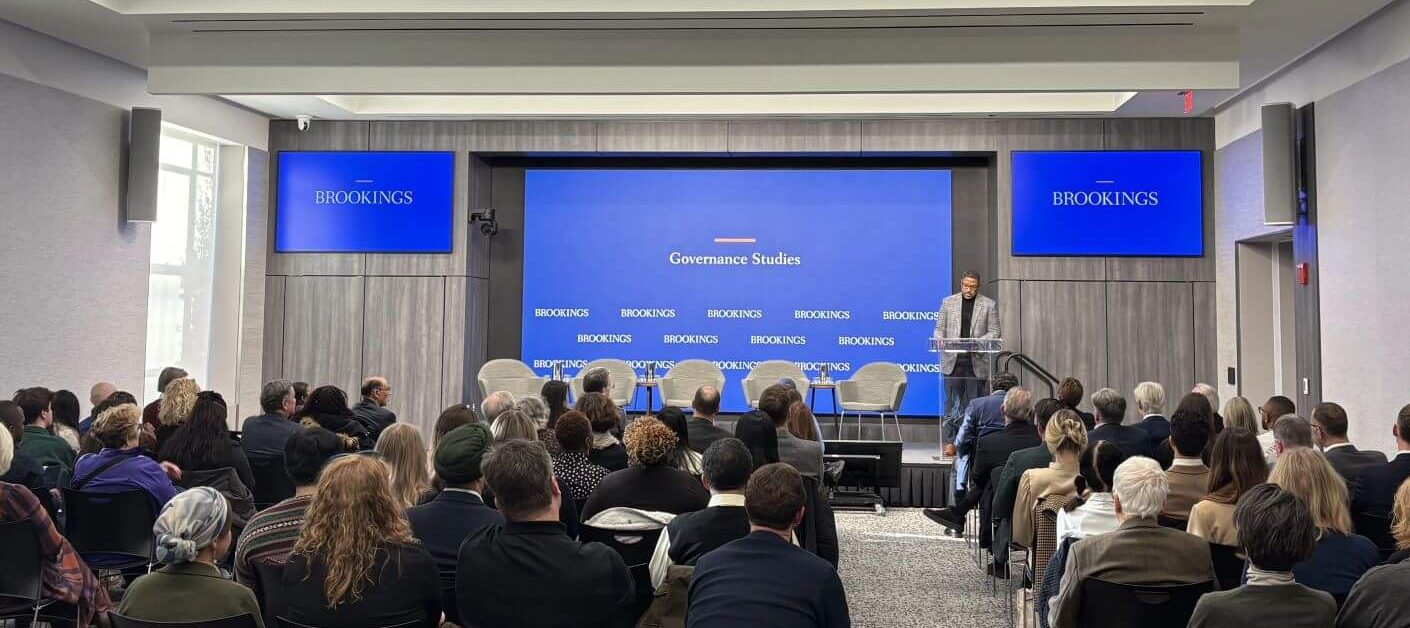
Opening Remarks
January 12, 2026
Brookings Institution
Washington, DC
“Good afternoon. It is an honor to be here today, and I am delighted to see so many friends and partners gathered for this timely conversation. I am grateful to the Governance Studies program at the Brookings Institution for partnering with us at Wake Forest University School of Divinity to convene this today’s discussion with our distinguished panelists.
“Our formal collaboration with Brookings extends back nearly two decades, to the beginning of President Obama’s first term with the publication of “Serving People in Need, Safeguarding Religious Freedom: Recommendations for the New Administration on Partnerships with Faith-Based Organizations,” authored by Melissa Rogers and E.J. Dionne and published by Brookings in cooperation with the School of Divinity’s Center for Religion and Public Affairs. That collaboration reflected a shared conviction – one that continues to guide our work – that questions of faith, freedom, and public life belong at the center of serious democratic and theological inquiry.
“Reinhold Niebuhr soberly reminds us that “[humanity’s] capacity for justice makes democracy possible; but [humanity’s] inclination to injustice makes democracy necessary.” Public theologians from Martin Luther King, Jr. to Pauli Murray to William Barber, have long challenged us to see democracy not as a finished arrangement, but as an ongoing project always in need of renewal, critique, and courage. Democracy does not sustain itself. It requires citizens and institutions formed in the disciplines of humility, accountability, and hope.
“It is quite fitting then that we gather for this public conversation near January 16th, National Religious Freedom Day. On that date in 1786, the Virginia General Assembly enacted the Statute for Religious Freedom, declaring that people are free to profess and maintain their religious beliefs, and that those beliefs should neither diminish nor enlarge their civil capacities. More than an act of disestablishment, the statute articulated a moral and political vision in which freedom of conscience was understood as essential to human dignity and democratic life
“Yet from its inception, religious freedom has been less a settled achievement than an ongoing and contested practice. It has been interpreted differently across time, traditions, and political contexts, requiring continual reflection on the relationship between religion and the state, the terms and limits of governmental authority, and the responsibilities that accompany freedom in a pluralistic society.
“That is the work before us today. This conversation asks not only how the Trump administration’s executive actions on religion should be evaluated as a matter of policy and law, but what they reveal about how religious freedom itself is understood, deployed, and contested in contemporary governance. Religion, when engaged with wisdom and care, can strengthen democracy by affirming human dignity and sustaining civic responsibility. At the same time, religion can be used in ways that divide, exclude, or undermine the equal standing of citizens – an ever-present danger that calls for vigilance rather than complacency.
“These questions are especially urgent in a moment marked by heightened polarization, democratic strain, and deepening diversity. How religion is interpreted and regulated by the state has profound implications for civil rights, immigration, education, health care, national security, and the very meaning of citizenship. As Martha Nussbaum reminds us, a democratic public ethic must combine equal respect for all citizens, rigorous critical thinking, and the imaginative capacity to see the world from perspectives other than our own.
“My own scholarly work has been animated by these tensions. I have critically examined religious freedom not only as a constitutional question, but as a lived reality shaped by history, power, race, and inequality. Religious freedom can serve as a source of moral witness and liberation, but it can also be mobilized in ways that obscure exclusion, reinforce hierarchy, and undermine the equal dignity of persons. Taking religious freedom seriously requires deep thinking, careful scrutiny, and critical adjudication underwritten and sustained by an ethic of democratic possibility
“These commitments are shared institutionally at Wake Forest University School of Divinity. Since our founding, we have worked to help students and communities understand religion not as a private or isolated phenomenon, but as a powerful force shaping law, public policy, civic life, and social movements. We prepare religious leaders, scholars, and public servants to engage the complex intersections of theology, ethics, law, and politics with intellectual rigor, moral humility, and ethical responsibility. Equipping leaders to navigate these realities responsibly is not ancillary to theological education; it is central to it.
“A distinctive strength of this work at Wake Forest is the close and sustained partnership between the School of Divinity and the Wake Forest University School of Law and my dear colleague Dean Andy Klein. Together, we bring legal analysis into sustained conversation with theological reflection and ethical reasoning through our joint degree program, courses, and public scholarship – modeling an approach to religious freedom as both a constitutional question and a moral one that requires attention to legal precedent, historical context, and lived experience.
“Our partnership reflects a shared commitment to public engagement and to the belief that universities have a responsibility to contribute thoughtfully to the common good. It also reflects the recognition that neither law nor religion alone can adequately address the challenges before us; each needs the other’s insights, critiques, and ethical imagination.
“It is with this spirit of openness and democratic responsibility that today’s conversation takes place. I am grateful for the expertise and insight our panelists bring, and I look forward to a discussion that deepens our understanding, sharpens our questions, and strengthens our shared commitment to broadening and deepening our democracy and the common good.”
Full Event Recording
About the Wake Forest University School of Divinity
Founded in 1999, Wake Forest University School of Divinity is a graduate, professional school that is Christian by tradition, Baptist in heritage, and ecumenical in outlook. Guided by the University’s motto, Pro Humanitate, the School prepares leaders informed by a theological understanding of vocation and equipped to serve as agents of justice, reconciliation, and compassion in a complex world. The School offers masters and doctoral degree programs including dual degree programs in bioethics, counseling, education, law, management, and sustainability.
Media Requests
Director of Marketing, Communications, & Public Relations
Wake Forest University, School of Divinity