

Liberation Theology is for Everyone
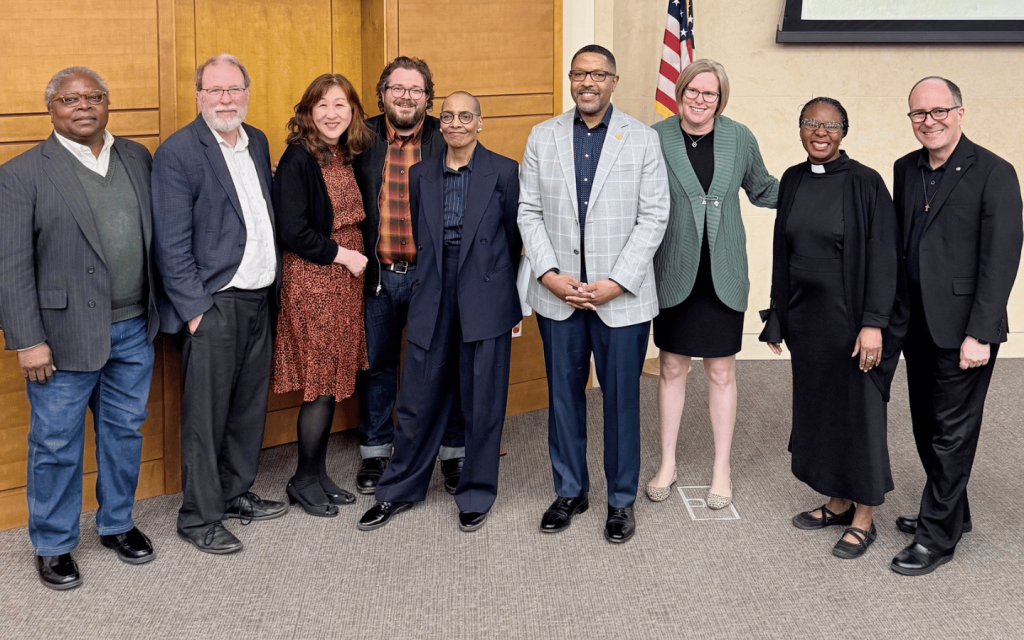
Photo credit: Grace Ji-Sun Kim
March 30, 2026
by Grace Ji-Sun Kim as published in goodfaithmedia
With wars raging in Iran and Ukraine, a world tarnished by racism, the climate crisis upon us, and deepening inequalities across the globe, a recent Wake Forest University School of Divinity conference on liberation theology could not have come at a more urgent time. In our context, theology cannot remain abstract or detached from the world’s troubles. Instead, it must address the realities of suffering and injustice.
I joined other theologians, including Dwight Hopkins, Edgardo Colón-Emeric, Kelly Brown Douglas, and Robert Ellsberg, to reflect on “The Future(s) of Liberation Theology,” moderated by Dean Corey D. B. Walker and Dr. Elizabeth Gandolfo. What unfolded throughout the day was not a singular narrative but a rich tapestry of perspectives and understandings of liberation theology from Latin American, Black, Asian, and womanist perspectives. Each voice brought its own historical context, methodological approach, theological emphasis, and urgency to our present-day problems.
Throughout our time together, it was evident that liberation theology is not a single, unified method but rather contains a multiplicity of diverse movements. Each movement emerges from particular struggles and develops with hope for justice and liberation. This plurality reflects the reality that since oppression is not monolithic, liberation cannot be either.
Theology is about speaking of God, and in our time, it must address questions of war, injustice, and suffering. These are not merely intellectual pursuits; they are core life questions shaping how we live. Liberation theology, then, is not simply doctrine; it is action and participation in creating a world beyond what currently exists.
Because we cannot fully comprehend the infinite nature of God, theology becomes our attempt to articulate meaning within our historical and cultural contexts. It is always partial and shaped by our lived experiences and our work toward justice.
In this way, liberation theology becomes our story of encountering God in the midst of the world’s brokenness, fear and agony. Since it engages real lives and unjust systems that cause harm, liberation theology is inherently political, confronting structures of power, naming injustice, and making a prophetic call for transformation.
Intersectional Theologies
Liberation theology is intersectional. Systems of oppression, such as racism, sexism, classism, colonialism, and environmental exploitation, do not operate independently. They intersect, overlap, and reinforce one another. Therefore, addressing one injustice and not others may lead to partial liberation.
Thus, intersectional theology, with its reliance on practice and movement toward justice, becomes a crucial way to engage in liberation theology. It enables us to understand the complexity of oppression and respond in ways that are holistic and just, as we all occupy multiple identities and places. It challenges us to move beyond single-issue frameworks and to recognize the interconnectedness of all struggles for liberation.
Crucial Questions
The Wake Forest conference closed with a panel in which all five speakers joined the audience in conversation. One timely question came from a Wake Forest M.Div. student, Mallory Challis, who asked about sexual violence in the legacy of César Chávez.
As stories emerge about abuse committed by revered leaders, we are confronted with a painful reality: Those who fight for justice in one arena can perpetuate harm in another. This is something that, for many women, is a lived reality. The revelation of sexual violence committed by Chávez exposes the deep entrenchment of patriarchy and misogyny present even in movements committed to justice.
Dr. Kelly Brown Douglas responded by stating even liberation theologians can be misogynistic, sexist, and patriarchal. This may be difficult to accept, but it is true.
If those who advocate for liberation fail to examine their own biases and behaviors, they risk perpetuating the very systems they seek to dismantle. Liberation theology must tackle not just one issue but all of them as they intersect and interconnect, which is why we need intersectional theology.
If we continue to uphold an image of God that is exclusively male, hierarchical, and dominating, we reinforce systems that legitimize male authority and female subordination.
Liberation theology is never neutral, as our images of God shape our social realities and our ethics. When God is imagined in ways that uphold masculinity, domination, and power, it becomes easier to justify violence and oppression against women. This is why feminist and womanist theological critiques are indispensable, as they challenge us to reimagine God beyond patriarchal frameworks and to recognize the full humanity and dignity of women. The liberation of women is also the liberation of men from entrenched misogynistic Eurocentric theology.
True liberation demands we confront all systems of oppression simultaneously as they intersect, such as gender justice intersecting with racial justice. We must recognize how sexism operates within Christianity, institutional structures, and society, and demand deeper accountability from men.
Without this critical intersectional self-reflection, efforts toward liberation will be incomplete or fall short. Hence, there is much hard work and activism ahead for all of us, but we do not despair, for we live in hope.
Hope is action and it leads us toward justice. With hope, we can envision new ways of being church and community and work toward an understanding of who God is, away from patriarchal and domineering images.
We must cry out for justice and center marginalized voices to move toward a more just and inclusive world. We must come together in this ongoing work of liberation to challenge unjust systems and to help create a world where justice and dignity are possible for all, especially for women who are too often oppressed and silenced.
About the Wake Forest University School of Divinity
Founded in 1999, Wake Forest University School of Divinity is a graduate, professional school that is Christian by tradition, Baptist in heritage, and ecumenical in outlook. Guided by the University’s motto, Pro Humanitate, the School prepares leaders informed by a theological understanding of vocation and equipped to serve as agents of justice, reconciliation, and compassion in a complex world. The School offers masters and doctoral degree programs including dual degree programs in bioethics, counseling, education, law, management, and sustainability.
Media Requests
Director of Marketing, Communications, & Public Relations
Wake Forest University, School of Divinity